Friday, May 17, 2013

Letter to a colleague: on LTTE

Back from the long siesta... Oh well, what goes up has to come down. Anyway. Here is a letter I wrote to a colleague on LTTE and terrorism.
-------

Here is a piece by Aatish Taseer in New York Times on the LTTE saga: (Linky). I thought I would comment on the article.
I am not sure if you know about Aatish. He is the son of an Indian journalist and commentator, Tavleen Singh, and a (now deceased) Pakistani politician Salman Taseer. Salman Taseer, as long as he lived, did not openly acknowledge Aatish as his son and Aatish primarily grew up in India with his mother. Towards the end, the father and son reconciled. But then, as fate would have it, Salman Taseer defended a Christian woman who was also accused of blasphemy and insulting Islam. So Salman got killed by a jehadi named Mumtaz al Qadri, who is probably in jail now but with a lot of sympathy from the general population of Pakistan which still sees this act as wajib-ul-qatl (crudely translated as due punishment for apostates, blasphemers and their supporters). Salman also had a visceral hatred for many things India, and it was an irony that just like most things in Pakistan, the primary thing that defined Pakistan (not being India with Islam being in danger in India and safer in Pakistan) goaded someone to kill another defender of the same idea. 

That partly explains Aatish's empathy for the Sri Lankan Tamils, at least in this article. I think the most common theme missed by many commentators on Sri Lankan matters is that things flow back and forth over time. The momentary hopelessness of the Tamil polity in forging their destinies is somehow seen as a bad thing or a good thing, if one gets emotionally invested in the situation. But if one discards that approach and sees things from an observationalist viewpoint, the triumphalism that is very common in the Singhalese population is pretty much a self-goal. Further, the triumphalism is displayed not only against the Tamils, but also the Muslims (who are also mostly Tamils, but never accorded that respect by either the Tamils or the Singhalese for their own complicated reasons). For their part, the Muslims have remained divorced from the violence of the different Tamil outfits, but there is often a last straw that breaks a camel's back. 

I will probably give the Tamils 10 to 15 years of cooling-off time before they start getting violent again. The one thing that is keeping the powder dry is the skewed demographics as of now, due to the emigration of Tamils to Europe, Canada and Australia and also the losses in the various wars. The Singhalese believe that posting ex-Army people in Tamil territories in the North and the East amidst the Tamil population would give them early warning signals of trouble that could allow them to ship soldiers to flashpoints, which is why they are speeding up infrastructure projects in collaboration with China. There are often limits to every such contingency measure. When things go unpredictable and belly-up, it is often a new issue that noone had imagined would happen which could then be post-facto rationalized -- the classical black swan argument or the argument on how complex systems fail. It is often not a single reason that causes things to go belly-up, its often a collection of small things just like in the Titanic or Pearl Harbor. 

I am not sure if there is a theory of self contradictory outcomes somewhere in the sociology literature. But one such candidate theory would be: any action that is well thought out to make a certain outcome less probable would often produce a certain other outcome which in turn could make the original outcome more probable. I am pretty sure that a variant of Murphy's laws can be twisted to this form. In any case, in the signal processing literature, we have a variant of this tradeoff called the bias variance tradeoff (Linky). To put it in simplistic terms, if the goal of an algorithm is to game/predict a certain unknown outcome based on indirect observations that are random, one could hope that the policies prescribed on average produce the intended outcome (no bias). But then with a certain realization of the observations that is actually seen, the variation from the intended outcome may be too huge so as to defeat and render useless the average property of this class. 

I think the Singhalese are trying too hard to game this scenario into the far future in case things go wrong. But there are simpler means to achieve that than by planting ex-Army men and land grabbing in what are seen as Tamil territories. I think reconciliation and trust is a better approach with some carrots and sticks. But then, we would nt have had the problem of the LTTE in the first place if reconciliation and trust was there to start with. The LTTE in itself came up only after the meltdown of the Bandaranaike-Chelvanayakam pact (the Banda-Chelva pact as it is called), the loss of trust by the Tamil people on a mostly-democratic outfit TULF, leading to violent outfits from which emerged the LTTE as the victor. 

I believe some form of reconciliation has been achieved in how the Government of India (GoI) deals with some terrorist outfits. Of course, some of it is purely accidental and somewhat deep-down philosophical in terms of approach and life, and not because of great planning. For example, when the Mizo National Front (MNF) abandoned violence in ~1986 in one of the northeastern states (with a mix of tribal groups of which the Mizos were the dominant demographically), the Chief Minister of the state resigned to pave the way for a MNF government followed by a general elections in which the MNF won the popular vote. This regime only lasted for a short while as the leader of MNF died of natural causes, but Mizoram has more or less remained peaceful relative to the otherwise violent Northeast of India. But to coax the MNF to the table, the Indian Air Force was used to shell civilian locations, one of probably very few (if not perhaps the only one) uses of aerial bombardment against civilians in India. 

The current model of dealing with what the GoI deems as the pro-talks faction of one of the major outfits in the Northeast, the ULFA, is also precisely this. The pro-talks leaders were all safely put up in Bangladesh, hosted by the various Islamist regimes under Zia-ur-Rehman, Hossein Mohd. Ershad and then Begum Khaleda Zia from the late 70s and early 80s till now. When a change of regime happened in 2009, GoI coaxed the Bangladeshis to hand over these people in return for a land swap agreement with net loss of territory for India (the final fruition of the Indira-Mujib accord of 1974) and water sharing on the Teesta river which is absolutely critical for Bangladesh. Neither of these has fruitioned now for Bangladesh, but that is a different story. The GoI has treated these ULFA leaders with a good amount of respect, even though electorally if they contest today, it will be a walkover for the current regime in Assam. I think the GoI will be happy to see them form a political party and burn their credentials over a period of time, as every terrorist outfit always does if it takes the democratic approach.

Historically too, that approach has been followed by the GoI in different forms. The Communist party formed the first democratically elected government anywhere in the world in the southern state of Kerala in 1956. Nehru, despite being a Fabian socialist and a good friend of Stalin, Brezhnev and Khruschev, was deeply suspicious of dictatorship of any kind, even the Proletariat one. So it did take a fair amount of moving away from his position via rhetorical gymnastics to allow the CPI to take over the Kerala government. The CPI takeover of educational institutions from the Catholic Church and the consequent violence led to the Constitutional use of an approach (now sparingly used, thankfully) to disband the state government. But I think the CPI has been coaxed into democratic politics with all the barrel of a gun speeches primarily restricted to rhetorical fanfare. This is a remarkable transformation which the Maoists accuse the Communists of. In fact, the Maoists would treat the Communists as their biggest enemies before attacking any other party in India today.

The same can be said about many other political parties in India in different states: DMK in Tamil Nadu, Shiv Sena in Maharashtra, Akali Dal in Punjab (which then splintered into many outfits with different consequences), Asom Gana Parishad in Assam, and so on. Even the definition of a successful terrorist outfit is not well defined. I believe the most successful ones are some of these political parties, DMK especially. Despite all these attempts over the years, India still has approx. 50-60 terrorist outfits, a good ~30 of them would be based out of the Northeast, ~10 Islamist outfits, mostly from J&K, ~10 Leftist outfits, and a few Hindu and Sikh ones. 

Its amazing that these attempts at neutralizing outfits, Indian style, has not been studied that much. There are a large number of lessons to be learned, good, bad and ugly, and one could try to discern conscious policies from historical accidents. The limits of predictability in policy making and the consequent agnosticism that brings into the picture have not been well understood, either in the Indian context or elsewhere, which is why we see folks keep getting too protective of their own ideas and turfs. Again, signal processing literature rescues us by allowing an inevitable Cramer-Rao lower bound to any estimator/predictor.
Further still, the metrics used for defining success for the outfit as well as the government is also needful of reassessment. A terrorist outfit would do well to transform to a political party that can pilfer the state coffers at will. The government would want this eventuality to happen as it would enhance the State's claim to suzerainty in a theoretical sense and would also be de facto assured in a practical sense with certain caveats. Yet, despite a commonality of eventual goals, we do not see all terrorist outfits abandoning themselves overnight. I think this is because terrorism is a cat and mouse game where from a game-theoretic viewpoint, the Nash equilibrium is clear. But both parties are greedy to seek a solution in the Pareto boundary that favors only itself. 

To connect it back, this is precisely what Prabhakaran was. Even amongst the greedy terrorist outfit chieftains, he was greedy beyond explanation. Which is one reason why the people who were coaxed into condoning him and his actions, either of their own free will or unwillingly, will have to bear the cross for his sins. But then this is just another short-term momentariness in a long-term back and forth, which could be easily predicted to a certain degree under the caveats mentioned above. 

Labels: , , ,

Tuesday, March 12, 2013

Academia, Radicalism, and the Publication Industry

Three small reports on these topics:

1) From Linky:
Cruz’s comments about Harvard echo the claims of other prominent conservative politicians and commentators, who like to assert that faculty lounges are nests of radicalism. But are they?
To answer this question, among others, I analyzed data from surveys and interviews with professors, including a nationally-representative survey of the American professoriate, conducted in 2006 with the sociologist Solon Simmons. My research shows that only about 9 percent of professors are political radicals on the far left, on the basis of their opinions about a wide range of social and political matters, and their self-descriptions (for example, whether they describe themselves as radicals). More common in the professoriate—a left-leaning occupation, to be sure—are progressives, who account for roughly a third of the faculty (and whose redistributionism is more limited in scope), and academics in the center left, who make up an additional 14 percent of professors.
Radical academics, it turns out, are overrepresented not at elite research universities, like Harvard, but at small liberal-arts colleges. Most are concentrated in a handful of social sciences and humanities fields, like mine, sociology (in which radicals are nevertheless in the distinct minority), and in tiny interdisciplinary programs like women’s studies and African-American studies.
But who are academic radicals, and what do they believe? This is a diverse category, encompassing social democrats, radical feminists, radical environmentalists, the occasional postmodernist—and yes, some Marxists. All told, about 43 percent of radical professors say that the term “Marxist” describes them at least somewhat well. (About 5 percent of American professors, over all, consider themselves Marxists.). 
In the course of seven years of research, I never encountered any radical professors who advocated “overthrowing the United States government.” Those who are politically committed to Marxism are profoundly concerned with economic inequality and class, believe that things aren’t going to get much better for people at the bottom of the income ladder unless capitalism in its present form gives way, and harbor some hope that things might eventually change—but are generally pessimistic. Radical academics vote Democratic in national elections, but do so holding their noses, seeing the Democratic Party and President Obama as far too centrist and business-friendly.
While it seems unclear that the specific professors at Harvard to whom Cruz was referring would describe themselves as radicals, it is the case that many radical academics see no point in trying to neatly separate their politics from their scholarship. Their academic analyses and teaching often have a political thrust. This can be a source of great tension not just with conservatives, but also with generally liberal professors who believe that politics, scholarship, and teaching shouldn’t mix.
Layered on top of these tensions are generational differences. The social unrest of the 1960s and 1970s led to an influx of radicals in the social sciences and humanities. Scholars who came of age in the 1980s and 1990s often took issue with the radical intellectual perspectives championed by their predecessors. Today a new generation of scholars, influenced by the Occupy Wall Street movement, appears poised to embrace radicalism once again, in the latest phase of a back-and-forth cycle.
Is it a problem for American higher education that 9 percent of faculty members are political radicals? The answer is that far-left academic radicalism is both a weakness and a strength. Were there no radical professors for conservatives to fulminate against—or had radical academics done more to keep their politics and their work separate—there might well be fewer political attacks on higher education today, and greater public support for colleges and universities. Radical professors in the post-1960s period overestimated how much tolerance there would be for them, and how far the idea of academic freedom could be stretched. Also, some academic radicals, privileging politics over scholarship, have waged unproductive battles against the scientific aspirations of their colleagues.
At the same time, academic radicals in the social sciences and humanities have given us novel and important ways of thinking about society and culture. They have alerted scholars and students to previously unrecognized dynamics of inequality around race, class, gender, and sexuality.
 2) On this count, its de javu time all over again in Tamland. An opinion piece motivated by Linky.

Student protests were last seen in Tamland in the mid- to late-50s and the early 60s on the "National Language" imposition issue. The Central Governments under Nehru and Shastri, both in terms of personal ideologies as well as pushed to the brink by the stalwarts who later dominated the Jan Sangh from what is now UP and Bihar and the aam aadmi on the street in quite a bit of "North India", as well as the local Congress regimes under Rajaji and Bhaktavatsalam badly botched their credibilities by pushing the envelope on the language issue.

Sadly, what that meant for the future of Tamland's electoral politics was that opinions got so badly polarized that there has hardly been a space/say for non-regional parties. And a common-sense perspective will be hard pushed to hope that there will be a say for national parties in Tamland in the near-future. And even more sadly, a Tamland precedent driven regional party culture has spread throughout much of India. While one can argue that this is both good as well as bad, precise answers depend on the issue at hand.

What should be the role of a State Government in foreign policy/diplomacy issues? Should WB get a veto over trade relations with Bangladesh, especially if it harms the milling industry in TN (Linky)? Should TN get a veto over bilateral relations with Sri Lanka, especially when there are ample reports on human rights violations on normal people independent of whether they are (former) members of LTTE or not? Should Bihar, Uttarakhand and UP get a veto over relations with Nepal, because of the Madhesi bonding across the borders? Should the states from the Indian Northeast have a veto over border demarcations on the contested India-Bangladesh border? Should a state (TN) have a say when the Central Government hands over an island (Katchhathheevu) to a neighboring country (Sri Lanka) for the sake of good neighborly relations, especially if it harms the livelihood of a subset of its peoples? Of course, Sarkaria commission recommendations do not study these aspects as these things seemed far from immediate in the mid-80s. Even then, the Sarkaria commission recommendations did not get fully enforced especially when it came to the dreaded misuse of Article 356 and one had to wait for the Supreme Court to have its say on the Bommai case, or in the case or river water tribunal recommendations on inter-state disputes where the Central Government could not enforce its neutral perspective due to political considerations. It is time that the Central Government constitute a new Constitutional panel on what should/can be the say of the various state governments on issues under the Central Government list.

But, without digressing, Tamland today is witnessing a student-driven protest time. Independent of whether they have legitimate issues (or not) to protest, and independent of whether they are being supported by anti-nationalist (perceived or real) forces or not, the new reality is that it does not take two to tango. Things do go belly up very quickly and fixing the ground realities and perceptions of angst against the Central Government's inactions take a long time. Further, these are needless issues at this stage in independent India's evolution given the enormity of crises at hand.

What should/could the Central Government do at this stage? Two things: the DMK is not the sole conduit of popular opinion on ground realities in Tamland for the Congress government at the Center. Opening a dialogue with the detested Modi-friend is not only the need of the hour, but also realpolitik. Opening dialogues with no-namers such as Vai Ko, Ramadoss, Seeman, etc., can be done on a need-to basis. But more importantly, opening dialogues with students is not needed to convince them of their futility, but to provide them with a hope that someone from the Central Government is respecting their opinions enough to talk with them. We often get talked to, it is hard for people to talk with. During the height of the language crisis, Nehru sent Indira Gandhi as an ambassador to open a dialogue with the local DMK leaders of that era. And Indira Gandhi did a great job in bringing the DMK to talk with the Center somuchso that the DMK chose to ally with Indira when the situation arose (1971 elections). That the DMK-Congress alliance went belly-up after that is great credit to both sides in the equation.

Without getting too regionally involved in how India chooses to vote at the UN, it is at least incumbent on the Central Government to explain how it has forced/coaxed/encouraged the Government of Sri Lanka to act on perceived human rights violations of Tamils in Sri Lanka, providing a shared vision of dignity and hope within a United Sri Lanka model, reconstruction of demolished temples and villages in the North and the East, etc. How has the Central Government aid announced in 2008 after the end of the War been spent? Any random observer would tend to appreciate the positive role played by the Central Government in this mess, provided they get to see its perspective. As a popular wisdom goes, Good Intentions are not Enough! It is time to talk, to people in Tamland, to the Government of Sri Lanka, to the Tamils in Sri Lanka, and especially to the protesting students in Tamland (independent of their utter stupidity).

3) And finally, from Linky. The report is best read pictorially.


As much as I would like to see the rise of China from a scary-eyed perspective, I would say, "bring it on." My personal experience having reviewed hundreds of papers (if not a thousand and more) that get flooded into the Manuscriptcentral system in EE from China, Korea, Japan, Europe, Australia, India, and even the US has been that most of the papers are junk with stale ideas meant to ensure that the CV gets padded by a few lines this way and that. The new competitiveness that I see from Chinese academics is not a great cause for alarm because of their uber-productivity, but a great cause of alarm for how they flood a system that is already strained at the margins (find three good reviewers for your paper and you will be in the 95th percentile and above in terms of how the review process works). In some of the high eigenfactor score journals, earlier, one could expect profound reviews that makes the author(s) think through their ideas once more. But these days, one should be very happy if at least one reviewer follows your idea deep enough to provide an intelligent response. The simple fact that I get at least a few review requests every week in an area that I have abandoned in all but spirit (and yes, I do accept every single one of them in the vain hope that I will uncover a brilliant idea before it gets published) just tells a random observer how remarkably over-strained the whole system is by the flooding that is CV padding. I pity the IEEE for it has become more of a company culture than a professional association-based community values driven culture --- a sad price to pay for globalizing engineering.

Coming up next: Making sense of the Northeast verdict 

Labels: , , ,

Tuesday, February 26, 2013

A thousand questions on Tamil-Singhalese relations

The 140 character Twitter mindset of today means that people often do not have the time or the patience or the enthusiasm to ask a thousand questions. Here, I start with a small set of questions on the Tamil-Singhalese relations. Of course, I do not know the answer to them all, nor do I have the time to address what I do know. May be, if and when time allows me (a big fat yawn!). But asking the relevant questions is an important task, and much more important than providing answers. So here they are.

Understanding the Tamil-Singhalese relations today cannot be ignorant or unmindful of history, a bad word for many people with an agenda that is uncorrelated with truth-seeking.

0) The very early immigrants from South India to Sri Lanka - now called the indigenous people (Yakkas/Veddas), even before the Singhalese and Tamilians migrated to the island.

1) Setting the stage -- Tamil migration patterns, Portuguese Inquisitions and the conversion of the Jaffna kingdom, Tamil-Singhalese commingling, formation of the Lankan identity

2) British era -- Impact of the British Rule on Tamil and Singhalese societies, The role of the Donoughmore and Soulbury Constitutions on Lankan identity and future makeup, Reforms in the Tamil Hindu and Singhalese societies, Cross-pollination of ideas between the Then Indhiya Saiva Siddhantha Sanmaarga Sangham and Lankan Tamil society, Flow of ideas from the Theosophical Movement to the Mahabodhi Society and the resurgence of Buddhism, Profile of elites in the Tamil, Singhalese, Burgher and Muslim sections of Lanka

3) Plantation Tamils and their travails in the context of Tamil and Indian migration to such places as Malaysia, Burma, Singapore, Guyana and the Caribbean, Fiji, South Africa, Kenya, and Mauritius. The similarities and differences with respect to hard labor, profile of societies migrating, etc.

4) Why did SL not join the Indian Union in 1948? There are good explanations why Nepal, Burma and Sri Lanka not join India upon independence, not all of which have to do with Nehru bashing. There was a good reason why the Burmans wanted to be out of British India in the late-20s to mid-30s. There was a good reason why the Tamils favored a Union with India after 1948, but the Singhalese did not. There was a good reason why the Kathmandu Valley based elite did not want a Union with India. There was a very good reason why Patel and Nehru did not force these neighbors to join India. There was a very good reason why Indira Gandhi annexed Sikkim. Some of these facts are to be understood in context of the information that India had at that point in history, not based on what we know now. Reshaping history based on future information is not only non-causal, but only ammo for rhetoric warfare with little meanings to reality.

5) Why was Katchhathheevu handed over to Sri Lanka? What was Sri Lanka's role in the 1971 war with Pakistan? How did the Soviets help India on the one hand and hurt India on the other? Who was responsible for the non-war on the West Pakistan side? And in this task how were they similar to the other superpower of that era? What were the commonalities between Sri Lanka, Maldives, Mauritius and Sri Lanka as virtual carrier fleets in the Indian Ocean? What did the Singhalese do to force the hands of the British and the Americans in taking over Diego Garcia, esp with respect to the Kankesanthurai port and Tirikonamalai air base?

6) G. Ponnambalam and S. V. Chelvanayakam -- their similarities and differences, their travails and their stories, their promises and their hopes for different sections of Tamils, and why these all got dashed by the Singhala Only act of the Sri Lankan Constitution.

7) Rise of YMBA and JVP -- Who was Rohana Wijeweera? Why was he allowed to run riot in Sri Lanka? What was the role of LSSP in the travails that led to the first JVP uprising? What was the Soviet role in this melee, particularly the Stalinists at the Patrice Lumumba University? How did Nehru react? How did SWRD Bandaranaike react? How did the Indian foreign policy change in response to the JVP threat? Why did the TULF constitute itself? What was the reaction in Tamil society at large?

8) Where did the TULF fail? Why did splinter groupings come up? PLOTE, EPDP, EPRLF, TELO, LTTE -- who supported them in TN and India? Why did MGR take a soft spot for the Kandy boys? Why did Indira Gandhi take a soft spot for LTTE initially? Why did the LTTE come up front and decimate everyone else? Who were Amirthalingham, Douglas Devananda, Mahathiya, etc.? What did the Vaddukkodai resolution promise? What was the impact of the Jaffna library burning in 1981 on support to the LTTE? What was the impact of the riots in 1983? Why did India help SL attain respectable cricketing status in 1983? What happened to the MJ Gopalan trophy between TN and Sri Lanka?

9) Why did Indira Gandhi go against the LTTE over time? What did Rajiv Gandhi take away from Indira Gandhi's tenure? How did Rajiv's tenure differ from Indira's? What led to the IPKF pact? What are the commonalities between the accords that Rajiv signed with AGP, Punjab, Mizoram and SL? What role did the air lifting of soldiers to the Maldives coup have on SL? Why was J.N. Dixit unsuccessful? What was the agenda behind IPKF? Why did the IPKF fail badly? Was the Tamil accusation that the IPKF soldiers commited rapes and brutalities right or wrong, fact or fiction? If it was fact, were such acts justified or not? Were the IPKF misunderstood saints or well-meaning soldiers or was the grayness somewhere in between? How did Indians react to stories of rape and brutalities on civilians unconnected with guerrilla warfare? How did the Sri Lankan Tamil society react?

10) How did the LTTE rise as a terrorist group? What were its strong points? What were its weak points in hindsight? What made LTTE what it was -- a fearful, loathsome, powerful outfit bonded by people with a need to free themselves from a fubar Singhalese society? What did India get right in its dealings with the GoSL and the LTTE? What did it get badly wrong? What was the role of Tamil "civil society" in TN on this issue? Who were TNRT and TNLA? What was the connection between Veerappan and VP? Why did Vai Ko rise in the DMK? What about Kolathur Mani and Pazha Nedumaran? What was Ramadoss' role in the SL issue? Where do all the politicians in TN fall in line vis-a-vis Sri Lanka? Where do they differ? What was Sivanthi Adithhanar's Naam Tamizhar Party's role in the SL crisis? What was the role of the erstwhile Raja of Ramnad? What was the role of Velankanni Church? What is the caste profile of the LTTE? Why did LTTE split not once, but twice? What was the role of conversion of a certain segment of Tamils to Christianity? Why did/do the LTTE and the Tamil Hindus share a painful relationship with the Tamil Muslims? Why was the LTTE still a rank-and-file Hindu dominated terrorist entity? How did Anton Balasingham become its advisor-cum-ideologue? Who was Adele?

11) Op. Oyaadha Alaigal -- the meaning of the idea and its ruminations in TN, the key players involved, the attack strategies, the Elephant Pass victory, the Palaly air base bombings, the Sea Tigers, the Air Tigers, Indian Coast Guard's role in coralling LTTE assets and how it failed miserably, military lessons to be learned, what lessons do they have for counterinsurgency operations in the Maoist heartland in India today, in India's extended neighborhood, for COIN against supposedly ethnic/political/azaadi-seeking terrorist outfits as against Leftist or anarchist terrorist outfits 

12) Political lessons for GoI, for GoTN, for SL society, for Tamil society, for Indians, for people at large. How will this issue end? Will it end? What can GoI do today? Why the past is a circle just like what the Buddhism's kaalachakra says about life? How the SL brand of Buddhism and the nonsense taught in Indian textbooks about Buddhism are not the same? Why some of the non-violence preaching societies such as Burma, Tibet, SL, Cambodia, Thailand, etc. are the most violent today, not only against other ethnicities of the same country, but also against neighbors? What lessons do Indians need to take from their surface level understanding of the conflict in SL? And finally, was Ambedkar correct in marshalling the SCs toward Indian Buddhism? What is the way forward for Indian Buddhists if that route was wrong? What would result in closure for everyone involved?

Labels: , , ,

Wednesday, February 20, 2013

On Balachandran Prabhakaran

A cliche to begin: if you are late in social media, you are a nobody. If you are early in research, even if not fundamentally deep, you are somebody. The point of the cliche being, I am always late: at work, at the blog, at life, yada yada, not that it matters to me, but it probably does in the grand scheme of things.

Much has been said in Tamil Nadu about the murder of the LTTE supremo's other son with widespread condemnation on the inhuman manner in which a 12-13 year old boy was murdered by the Sri Lankan army, possibly on orders from the high command at the Government of Sri Lanka. There are clearly many ways to dice and slice this scenario: from a human rights perspective, from a cold-hearted military perspective, from a realpolitik perspective, via a post-facto rationalization spree, and so on. Neither perspective can fully justify any action either way. While noone made a big fuss when pictures of Charles Anthony's bullet ridden body or that of Prabhakaran's blasted head were released by the Sri Lankan army, not much has been said about the bullet wounds to the heads of Dwaraka and Mathivathani --- the latter who happens to still have extended family in Tamil Nadu which I personally know of and hear from often enough. Not much has been said on why these two females were culpable in the orgy of crime instigated by the LTTE that necessitated their murders too. Not much has been said about the fact that Prabhakaran, Charles Anthony and Balachandran are/were all obese for their age --- a sad reflection of how a once-feared guerrilla army had come down to in its last ride to hell.

Not much has been said about the timing of this expose, coming from the stables of The Hindu and Channel 4. Was it intended to create a sympathy wave that could reflect positively on commuting the life sentence of the LTTE members who were actively involved in the Rajiv Gandhi assassination case? Or was it intended to force the Government of India to vote against Sri Lanka when the UN vote comes to the picture again in mid-March? Should we expect pictures of sexually abused family members of the LTTE supremo's family in the next expose? Not much has been said about the fact that whatever may be one's opinion on this matter, the verdict as seen from the "Comments" section of The Hindu (which reflects the comments one hears in the news media in TN) is overwhelmingly clear that TN does not see this murder in a positive light. That alone is sufficient to sustain this religious fistfight between the Tamils and the Sinhalese for the next few decades.

For people directly connected to the Indian armed forces and the sad IPKF wounds of the past, none of these would of course matter. The LTTE deserved to die and anyone frontally or peripherally or tangentially associated with that entity should pay the big price for the necklace bombs and the coffins that returned from Sri Lanka. Yes, they should pay the price. But how does that square with the fact that the war in Sri Lanka is a pure religious war? How does that square with the fact that the overwhelming majority of Tamils in Sri Lanka, most of whom are still Hindus, see this as a religious war even if most of their extended Hindu neighbors in India or TN do not/cannot/will not want to see it as?

A recent report by the International Policy Digest had these facts to note:

This paper will show that the concept of Sinhalization extends well beyond the subjects of strategic state-planned settlements, land, military intrusion, boundary changes and the renaming of villages. Sinhalization has made its way into Tamil cultural events, religious life, economic activity, public sector recruitment and even the Sri Lankan education system. Since the Tamil community is attempting to recover from the devastating impact of the civil war and rebuild social networks and community structures, attempts to control and demolish socio-cultural aspects of their lives, such as the take over and destruction of temples, inhibit their attempts to engage in emotional healing and community regeneration even minimally.  
Land schemes began in earnest after Sri Lanka gained independence in 1948 with D.S. Senanayake, the Minister of Agriculture and Lands from 1931-1947, leading the way. Land located near Pattipalai, Kaluwanchchikudy, Batticaloa was renamed as "Gal Oya." At least as it relates to land, this constitutes the formal beginning of State-sponsored Sinhalization in the country's eastern province. In the post-independence era, one of the first development projects inaugurated by the Government of Sri Lanka was the development of Gal Oya Valley, a part of Gal Oya basin. At its inception, the Gal Oya project was the "largest settlement and resettlement" program that had ever been attempted in Sri Lanka. Under this project, more than 80,000 Sinhalese people settled into predominantly Tamil areas from 1949 to 1952 and Sinhalese settlement continued in the 1960s. 
The "Mahaweli plan" set the tone for the highly exclusionary development policies that continue today. Though initially designed as a thirty-year year plan, President Jayawardene announced the state's intention to "accelerate" the plan to a five-year project. The "irrigation plan" was supposed to settle over 700,000 people within six years. Two thirds of Mahaweli plan was situated in the country's North and East and sought to give the Sinhalese-dominated State the chance to take "advantage of land and water resoirces which exist in these areas." The implementation of this project did two things. First, donors benefited from the plan's economic success (the project's cost-benefit ratio was 1.57), thus enabling certain debts to be repaid. Second, and more importantly, the plan drastically altered the ethnic composition of the country's North and East, giving the Sri Lankan State more authority to arbitrarily redraw provincial and district boundary lines.
Fast forwarding to the post-LTTE era, here are some anecdotes from the pdf:
1) Since 2006, nearly 100 village names have been changed from a Tamil name to Sinhalese ones. While it is not possible to obtain more precise numbers, much of this renaming has occurred since the end of the civil war. 
2) The expansion of the military's presence in predominantly Tamil areas has done little to quell the anxieties of ethnic Tamils. Some people fear even greater military expansion in certain areas, including the building of new bases. The State's defense budget will exceed $2 billion (USD) this year, a nearly seven percent increase from the previous year. 
3) The State also recently announced that security forces and the police who have a third child would be paid a 100,000 rupee incentive, thereby cementing the special position enjoyed by the military in post-war Sri Lanka. Since the military is almost exclusively Sinhalese, this is disturbing and discriminatory. It is worth noting that while members of the armed forces are being provided a financial incentive to expand their families, Tamil women in the Hill County are being paid 500 rupees to undergo an irreversible sterilization procedure. 
4) During the civil war more than 350 Hindu Temples in the country's North and East were demolished. The actual number of Hindu Temples destroyed in, almost certainly, much greater than list provided in this monograph. In other cases, army personnel continue to occupy Hindu temples, some of which are located in de facto HSZs. Relatedly, the State has been building Buddhist shrines and other religious monuments where some of these Hindu temples existed.
In the Hill Country there is a historical Tamil site in Ratnapura called Sivanolipathamalai (Adam's Peak). This is a famous holy site for Hindus and many used to engage in religious rituals there every year. Since 1900, the site has welcomed people who spoke English, Sinhala and Tamil. However, in the 1970s, the site was given an exclusively Sinhalese name and is now called "Sri Pada." Right now, importance is only given to Buddhism and the location has been officially denoted as a Buddhist holy site by the State. The administration of this site is managed by Buddhist monks and Hindu rituals are no longer permitted in Sri Pada.
5) And more on the military takeover of economics in the pdf
The bottomline is simple. Realpolitik dictates that demography is destiny and the Sinhalese government is pursuing the grand strategy of demographically manipulating Sri Lanka's destiny as a Sinhala state, in name, spirit and action. In this sarukku maram game, Sri Lanka unfortunately perceives TN as a grand enemy and the Tamils as people belonging to TN and not to Sri Lanka. This is how it has been for a looong time and this is how it remains today. While the Tamils (in Sri Lanka and TN) do not perceive themselves to be a part of such a game theorizing, perceptions can lead to realities and the Tamils in TN will be forced to play the game in bigger numbers (they have already been playing this game for a while now, but only a small part of TN). It is only a playback of the past 60 years of TN-Sri Lanka history. The strategic depth that Sri Lanka fears, which is almost absent in real-life except for a microscopic minority (that may or may not matter much), will over time become more dominant and a bipartisan support to a neo-LTTE-type organization by the political parties of TN cannot be wished away. Sadly, that day is closer to today than I would like it to be. And even more sadly, it is hard to not look the other side when such a support cast develops because even if you are an atheist, your religion is still your bloody religion, even if practiced and followed by a hundred buffoons of hundred types.

Labels: ,

Thursday, March 22, 2012

Comment on LTTE and some other general comments

Precedent or "You got what you deserved": There is much consternation on Government of India's stance to vote against Sri Lanka at the UNHCR. While the vote led to an alignment of interests between human rights-peddlers of the free world and India, it comes amidst the drama of the U-turn on the "13th amendment and beyond" (Linky). Any Indian in his/her rightful mind would not argue twice when the Government of India takes the onus to speak the same forked tongue that statesmen from abroad indulge in, innit?!

Hero-ization of SL for putting down the LTTE: There is a dramatic heroization of the Government of Sri Lanka's efforts in defeating the LTTE militarily. Needless to say, while this was a great showcase for military pursuit against an unconventional status-quoist enemy, this was not an extreme exception by any means. In India, we have put down unconventional rebels with considerable venom over the years: Khalistani terror, Mizo National Front, etc. come to the forefront right away. As the border has been sealed, even J&K is slowly but considerably steadily moving to being a zone of peace where even borderline human rights violations get the short shrift of the people these days. Even as we speak, UPDS, ATTF and NLFT are in the long process of being coerced and socially and politically co-opted into accepting the path of democracy while a long-drawn battle on the NSCN-IM is unfolding at a politically glacial pace, but not so glacial for the counter-terror industry.

Further to speak, all this hero-ization business will fall by the wayside with the introduction of one silly statistic (see Footnote 1) from counter-terror literature: from 1970 to 1997, 74.72% of the world's terrorist groups lasted less than 1 year, 14.77% lasted between 1 and 5 years, 4.62% between 6 and 10 years, an equal 4.62% between 11 and 20 years and only 1.26% over 20 years. In other words, only 1 in 100 terrorist groups lasted longer than a generation and around 3 in 4 fell within a year. While that statistic can be read either way depending on your choice, it just speaks enormous amounts on how the writ of the State shall eventually prevail no matter what. Lo and behold, a terrorist group does indeed win "freedom", it has to morph overnight into becoming a legitimate Government (as happened in East Timor) and put the house in order. In other words, there are no permanent terrorist groups in the world, only permanent strifes in one form or the other.

More to speak, Sri Lanka does nt fit within the theme of one of the most deadliest places on earth even when the LTTE ran amok liberally in the North and East of Sri Lanka. That distinction goes to Latin America as FARC, Shining Path (or Sendero Luminoso as they called themselves), ELN, FMLN and other leftist inspired groups ran riot. The glory days of FARC and Shining Path are long since gone as Project Colombia has put down the narco industry quite badly. Even ETA and IRA were far more deadlier than LTTE and needless to say, both have been put down more or less. All this makes this dramatic hero-ization of the valor of the Sri Lankan army a moot point in some vague sense. Sure, many a soldier must have died valorously for his country and homeland, but to make it a tale of the day might be a theme for the naive.

Elsewhere, hockey group in the Olympics: India is clubbed with Germany, Netherlands, South Korea (the winner in the second leg of the qualifiers), New Zealand and Belgium at the London Games. Of these five matches, three are not-so-bad at all. Despite the high ranking of some of these opponents, wins should be the normative course against New Zealand, Belgium and South Korea. A draw against Germany should take us through to the semi-finals. Of course, for the Indian team conjuring up a draw or a defeat in the last minute is also not so abnormal, so take that bad omen with a punch of rum and salt!

Exasperated, but then what else is anew? Elsewhere, the developmental squad sent to Pakistan is loaded with players from one or two regions yet again. This time it is the turn of Coorg/Karnataka and Punjab. While some of the members in that squad are well entitled to even be in the National team, some are just baggages or rather unproven commodities with a big claim to a big-ticket exposure trip. This is the same incident that was seen at the Johor Bahru junior tournament where players from Punjab were stacked up, most of whom who took part in the WSH event have been let go and a new bucketload of prospects have been picked. A very professional way in which HI handles the junior leg of the sport. But that should not be surprising given that even worser treatment is meted out to coaches such as Mukesh Kumar and regular players like Sandeep Singh and Sardara Singh for playing in the Belgian league early last year.

Hostage taking incident in Orissa: The interlocutors for the Italians taken hostage by the Maoists are arrested Politburo member Narayan Sanyal, Dandapani Mohanty and Biswapriya Kanungo. D. Mohanty was an interlocutor in the Vineel Krishna hostage incident (along with Prof. Haragopal and late R.S. Rao).

And finally: Another series of silly statistics that puts down endless ululates (often me included!) on how the Indian academic market pays peanuts for its Professoriate. India has consistently ranked in the top 10 on paychecks adjusted PPP-wise (Linky) and is much better than even the US. Only Nigeria and Ethiopia best India on the ratio of monthly academic salary at public universities to the GDP per capita per month metric (Linky). India is one of the three countries to have housing projects mandated by law (Linky) and other supplementary benefits best the "poor pay" (Linky). All this confirms my long-held belief that NRIs who are gainfully employed in the education industry do not return to India not because of poor pay, but because the ecosystem of peer excellence has not reached critical mass, YET. When the critical mass is reached, the trickle shall become a deluge, needless to say.

Footnote 1: While this data is not exactly complete, it is not an unrepresentative sampling either.

Labels: , , ,

Friday, November 11, 2011

Turn the other cheek diplomacy

The recently concluded 17th summit meeting of SAARC leaders at Addu city has come in for criticism on the "appeasement" policy followed by the Indian PM, Shri. Manmohan Singh. Specifically, one commentator states that: Linky 1

However, the Addu Declaration has failed to address India's concern on terrorism.
...
Given the fact that India has been a victim of cross-border terrorism for more than three decades now, and by the admission of Pakistan's Interior Minister Rehman Malik that "incidents like 26/11 happen every day in Pakistan," the Addu Declaration has clubbed terrorism, transnational organised crimes, illegal trafficking in narcotics and psychotropic substances, illegal human trafficking, piracy and smuggling of small arms together, albeit briefly.

One certainly cannot be in an eternal state of aggressive diplomacy (aka) jingoistic fervor to make a point. Given the enormity of challenges in ensuring connectivity to the Northeast of India, and securing energy resources from Nepal and Bhutan in a grid that spans India and Bangladesh, it would have been suicidal to score an own goal of further persisting with an India-Pakistan equal-equal. India needs to handle Pakistan and vice versa, but these are bilateral issues that need not stalemate a multilateral initiative such as SAARC. In fact, given the Indian reluctance to make J&K, crossborder terrorism as de jure multilateral initiatives, it has been a big surprise that a forum such as SAARC has been hijacked by the India-Pakistan status quo. Divorcing Indian problems with cross-border terror emanating from Pakistan in a multilateral setting that allows the leeway to speak broadly and widely and cutting across many boundaries can at best be termed "Turn the other cheek" diplomacy, at worst as sell-out. I would rather have it the former than the latter. At the very least, it behooves to understand the Prime Minister's logic before mounting noisy protestations at his supposed "sell-outs."

1) From his inaugural address at the summit: Linky 2
On cutting down the sensitive list:

I am happy to announce that, in a major trade liberalization effort, the Government of India has issued a notification to reduce the Sensitive List for the Least Developed Countries under the South Asian Free Trade Area Agreement from 480 tariff lines to 25 tariff lines. Zero basic customs duty access will be given for all items removed with immediate effect. I recognize that non-tariff barriers are an area of concern. India is committed to the idea of free and balanced growth of trade in South Asia. Competition begins at home. Our industries have to learn to compete if our economies are to have a future in this globalised world that we live in. We can all benefit from our respective comparative advantages. These include our hydropower and natural resource endowments, possibilities of earnings from transit, marine resources, our scientific and technological base and above all our young population which will drive consumption and investment in the years ahead.

On connectivity issues:

The theme of this year’s Summit is “Building Bridges”. This eloquently summarizes the imperative of greater regional integration, and is an objective to which India is fully committed. One such initiative taken last year was the launch of the South Asia Forum that has brought eminent South Asians from different walks of life together. In our Summit in Dhaka in 2005, I had suggested a reciprocal initiative to provide unrestricted access to airlines from SAARC States to our four metropolitan cities, and to 18 other destinations in India. Connectivity has partially improved since then. We must take this further. We should aim to conclude a regional Air Services Agreement, for which India would be happy to host a meeting of officials next year.

We have been talking of a Regional Railway Agreement and a Motor Vehicle Agreement for a long time. Let us agree to conclude these agreements as a matter of priority. India, Maldives and Sri Lanka are in the process of developing regional ferry services. We should replicate many more such connectivity arrangements in other parts of our sub-continent.

I commend the Postal Administrations of SAARC for agreeing to establish a South Asian Postal Union. India is happy to host the ad hoc Secretariat for the Union, and to sponsor training courses at our Postal Staff College to train upto ten SAARC officials per year, belonging to interested Member States. We should follow up this agreement by improving our telecommunication linkages to reduce call rates and telecommunication tariffs and interconnection termination charges. India will be ready to facilitate the development of a regional telecommunications infrastructure to improve the quality of connectivity. We should encourage greater broadcasting, television and film exchanges among our countries. It is time that we overcome the information deficit among the SAARC countries. We should encourage our people to know more about each other.

In this spirit, I wish to announce the following initiatives that India will take.

We will host a conclave of the top dozen tour operators from the SAARC region to boost tourism exchanges. We will take the initiative to establish a travelling exhibition on the ancient history of South Asia. This could comprise of a hundred archeologically-significant pieces per country to be selected by member States. The exhibition can be hosted in each of our national museums in turn for three months. Post-graduate courses in the South Asian University have started in July 2010. India will increase the number of SAARC Silver Jubilee Scholarships for the South Asian University from 50 to 100. 75 of these will be at the Masters level and 25 at the doctoral level.

On environmental matters:

Protecting our environment even as we pursue rapid growth is essential. The India Endowment for Climate Change which I had announced last year has been established. We look forward to receiving project proposals from our SAARC partners. We will provide a total of ten scholarships per year to SAARC Member States for post-graduate and doctoral studies in forestry courses at the Forestry Research Institute of India, Dehradun.

2) As a consequence of the push: Linky 3

In his address during the inauguration of the summit on Thursday, Prime Minister Manmohan Singh had called for full implementation of his six-year-old proposal for unrestricted access to airlines from SAARC states. He had also suggested giving priority to a Regional Railway Agreement and a Motor Vehicle Agreement. The declaration made no mention of an air services agreement but met Dr. Singh's desire for SAARC-wide ferry and rail services. In the absence of seamless air, rail and sea connections among SAARC member-countries due to traditional animosities, unsettled conditions and apprehension about the other country's designs, the common man travelling between some SAARC countries is forced to take circuitous routes. In this respect, the eight leaders at the summit decided to finalise a Regional Railways Agreement and complete the preparatory work on an Indian Ocean Cargo and Passenger Ferry Service by the end of this year.

3) From the Addu declaration, some points that need highlighting: Linky 4

7. To direct the conclusion of the Inter-governmental Framework Agreement for Energy Cooperation and the Study on the Regional Power Exchange Concept as also the work related to SAARC Market for Electricity.
...
11. To initiate work towards combating maritime piracy in the region.
...
19. To undertake a comprehensive review of all matters relating to SAARC’s engagement with Observers, including the question of dialogue partnership, before the next Session of the Council of Ministers in 2012.

4) More on the observer issue: Linky

India today persuaded other Saarc member-countries to undertake a comprehensive review of the association’s guidelines for granting observer status to other nations.
...
A three-year moratorium on admitting new observers ended this year. New Delhi believes the existing nine observers is one too many for the eight-member Saarc. The observers are the US, Australia, China, Iran, Japan, South Korea, Mauritius, Myanmar and the European Union. India’s concerns stem from member-countries, particularly Pakistan, pushing for China to become a more involved partner. New Delhi does not want Saarc to become Beijing’s playground. It also has reservations about Pakistan support for Turkey’s bid to become an observer.

5) Four agreements were signed at Addu city:

a) SAARC Agreement on Rapid Response to Natural Disasters
b) SAARC Agreement on Multilateral Arrangement on Recognition of Conformity Assessment
c) SAARC Agreement on Implementation of Regional Standards
d) SAARC Seed Bank Agreement


As I point out elsewhere, the primacy of an Indian-centred electricity grid that is shared with Bangladesh and Sri Lanka and that is supplied by the massive hydro potential of Bhutan, Nepal and surplus power states of the Indian Northeast such as Arunachal Pradesh can go a long way to address the burgeoning demand for electricity in India and its neighborhood. Nuclear power can only go so far, and there is a need to diversify the sources of cheap and sustainable power. That does not make renewable power an alternative model for electricity generation discourse in India. Nor does it condone the criminality of transmission, distribution and pilferage losses.

Labels: , , , , , ,

Monday, October 31, 2011

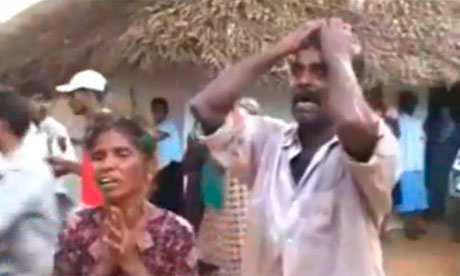
Sri Lanka's Killing Fields - October 2011 Report


Image courtesy: http://www.guardian.co.uk
All anecdotal accounts from India talk about the horrible human right violations on the Sri Lankan Tamilians. The Sri Lankan tamilians were first treated horribly by Government of Sri Lanka, then by their own 'movements' that championed their cause to only let them down in the long run. LTTE systematically obliterated other Tamil groups first, and positioned itself as the sole savior.

Meanwhile,  Channel 4's Sri Lanka documentary cleared by Ofcom. Dorothy Byrne of Channel 4 complains about the PR lobbying by Sri Lankan government and others:
Sri Lanka's Killing Fields, which was broadcast in June and featured graphic footage of alleged war crimes, faced a demonstration outside Channel 4's London headquarters – which she claimed had been organised by the Sri Lankan ministry of defence.
Flash back to the 80s and 90s....

The Dravidian parties of Tamil Nadu saw a tremendous opportunity to sway the emotions of tamilians in Tamil Nadu to get votes. Vaasanthi in her book "Cut-outs, Caste and Cine Stars" quotes Karunanidhi:
If the Center can support the Palestinian struggle for a homeland , why does it not back the movement for a Tamil Elam?
As the Dravidian parties vied for attention by spreading awareness of the Sri Lankan tamilians conditions and demanded that India do something about it, the leaders in New Delhi were worried as it eerily reminded them about the demand for 'Dravida Nadu'.  MGR for his part offered patronage but was opposed to Tamil Elam and any armed support. During the IPKF operations in Sri Lanka, many of the Tamil Nadu politicians complained about the Indian Army 'excesses'.

For their part the Tamilians of Tamil Nadu, initially had sympathy towards the Sri Lankan Tamilians, but as LTTE decimated the other tamil groups and violence along the coastal regions of Tamil Nadu increased because of bomb blasts, looting and fratricidal war between Tamil Groups, the Tamilians in Tamil Nadu began to distance themselves with the thought "I am Indian, only next a tamilian".

Tamil Nadu, its people and prominent leaders turned against Sri Lankan Tamils after LTTE assasinate Rajiv Gandhi. Karunanidhi sobs to Vaasanthi and she writes in her book:
I trusted them, amma. We were all genuinely moved by the Tamil's plight. These boys [Pirabakaran and his associates] looked so innocent and gentle in their manner......... I was too shocked when such a massacre happened right here in our streets. From then on I decided to have no more truck with them. I stopped seeing or talking to them.
The poor Sri Lankan Tamilians first had to suffer at the hands of Buddhist Sinhalese, Government of Sri Lanka and its army and then their own movement committed atrocities against each other to the extent they did little for the true cause. India was helpless. Or was it? I for one wish India showed some spine and had decisively acted to make an impact.

Fast forward to 2011....

Tamil National Alliance leaders are meeting US & UN officials in America. A UNRIC report laments the bloody past of a beautiful island. Alan Keenan, Senior Analyst and Sri Lanka Project Director for the International Crisis Group (ICG) says:
We need an open political structure in Sri Lanka. The president and his two brothers control all the most important ministries and around 75 % of the national budget. This is not a positive scenario for addressing the damage done to Sri Lanka’s political institutions from decades of war and terror. Equally worrisome, there are no signs the government is especially interested in addressing the political marginalization and grievances of minorities by including Tamils and Muslims equally in political life, not only nationally but locally. And if they are not interested in correcting the mistakes of the past, their policies risk sowing the seeds of future conflict.
The Sri Lanka Broadcasting Corporation sees it blames it all on LTTE supporters. It is the bad luck of Sri Lanka, that LTTE chose to be the champion of their cause. Every sane group or individual, on hearing the name of LTTE steps back and stops talking about Sri Lankan Tamilians. Ironically LTTE helped the Sinhalese more than the Tamilians. Sad.
An attempt made by few western countries to appoint a Human Rights commissioner for commonwealth countries was ended up a in a failure due to strong protest staged by majority of members including India and Sri Lanka. At the commonwealth meeting representative of those countries pointed out that such an appointment would lead to interference of internal affairs of member countries. The attempt made by some  pro-LTTE elements to discredit Sri Lanka was also failed. Majority of members have extended their support to Sri Lanka and praised the country’s economic growth following the end of terrorism.
While others see the attempt to set a Human Rights Commission as Western Imperialism and considers Gaddafi was a friend in need. While a whole lot could be written about USA and UK and their hypocrisy, Libyan Dictator and Sri Lankan Army make strange bedfellows. Sri Lanka cannot cite Libya, UK and USA's actions and inaction and excuse itself of its treatment of fellow citizens and its own war crimes.
  It would be recalled and must never ever be forgotten that when the sanctimonious affluent western nations such as United States and Great Britain strained every nerve, muscle and fibre of their beings to prevent us from liberating our country from the cancer of terrorism by starving us of funds – i.e. by preventing the IMF from giving us the standby facility of some US $ 500,000,000/-, it was Gadaffi who came to our aid by offering us money. It was only thereafter that the IMF agreed to give us that facility.

On the other hand, a couple of days ago, there was joy in certain quarters that the noose tightened on Rajapaksa:
Colonel Qaddafi appeared to be a saint compared to President Mahinda Rajapaksa and how he would extricate himself from the mess he embroiled himself into, only time will tell
Gaddafi and Sri Lanka's ties did not go unnoticed after Gaddafi's death. Media compared China's muted response to Sri Lanka's demand for an explanation. GoSL's stance on its own human rights was pointed out.
Gaddafi was a close friend of the government of Sri Lanka and of President Rajapaksha. One of the last politicians to have a photo opportunity with Colonel Gaddafi was President Rajapaksha’s heir apparent, his son and M.P. Namal Rajapaksha.

Only a few countries condemned the killing of Gaddafi in such a cold blooded manner. The government of Sri Lanka, although it did not condemn the killing, called for an explanation of his death. A number of government ministers have condemned the killing. Issuing a statement consisting of 21 words in one sentence, the government of Sri Lanka said: ” “The Government of Sri Lanka is of the opinion that the circumstances surrounding the death of Colonel Muammar Gaddafi require an explanation.”

This statement is commendable especially in the context when even a country like China, which has been a stronger supporter of Gaddafi and his government, issued a more muted statement. The statement by China’s foreign ministry said: ‘Gaddafi’s death marks the turning of a page in Libya’s history.’ China also called for a rapid launch of an inclusive political process to find unity in the country, and the launch of economic restructure, to make its people live peacefully and happily.

The statement of the GOSL is indirectly calling for an inquiry into the incidents which led to the death of Gaddafi. A proper explanation can only be possible after an impartial inquiry. Here we can see that the GoSL is of the same opinion as Human Rights Watch and Amnesty International. Both organisations issued strong condemnations of the killing and called for a proper investigation and justice.

Both these organisations have called for such investigations regarding the alleged killings that had taken place in the last phase of the war with the LTTE in Sri Lanka. They have provided evidence of individuals killed while in detention. One such case is that of the Eastern province LTTE leader Colonel Ramesh. The video footage of Ramesh being questioned by Sri Lankan military personnel, and of his dead body, is available even on the internet. A number of wives of former LTTE leaders came before the Lessons Learned and Reconciliation Commission of the government and said that their husbands surrendered themselves to the military; their whereabouts are unknown after that.  The Sinhala language newspaper Divaina reported that a number of LTTE leaders were in military custody and printed their names. (The newspaper later retracted the story.)
While the West and Sri Lanka fight on, India stands doing not much for a country that is practically in its backyard.  I think it is India's wishy-washy stance that emboldened the Sri Lankan government to commit atrocities against Tamilians. Well, it would be germane to ask "What should India have done?" My answer: "Something different from what it did." India cannot be blamed, but dil mangtha hain more from; if India could not have influenced Sri Lanka, little could other countries do. And if India had been little more active, the 'Evanjihadists' influence on the Tamil groups could have been controlled. Or probably not. We would never know.

Buddhism stands along Islam as another religion of peace. I am positive Buddha would be greatly troubled, and maybe we can lay all the fault at Asoka's feet for spreading Buddhism in 'Ceylon'.

Labels: , ,

Tuesday, August 23, 2011

India-BD bhai bhai, season for unilateral concessions?

1. Teesta agreement:

The 60-year-old Teesta dispute between India and Bangladesh could become a thing of the past with Delhi likely to agree to a 50-50 water-sharing deal, an official source in Dhaka has said.
...
The two sides have agreed to a 50-50 water-sharing deal that has been a longstanding demand of Bangladesh, the source said, but there could a rider in the pact favouring India. Delhi may want to draw more water at certain times of the year, he hinted. Bansal is expected to sign the deal for a 15-year term and leave before Singh’s arrival, he added.
...
Bangladesh Prime Minister Sheikh Hasina is said to be under tremendous pressure to extract a fair deal from India because the dispute has become an emotional issue in her country.

How about a fair deal to West Bengal?

According to media reports in Bangladesh, International Farakka Committee chairman Atiqur R.K. Eusufzai, a leading water activist, favoured setting aside at least 25 per cent of the water for the river and splitting the rest — 60 per cent for Bangladesh and 40 per cent for India. Delhi is unlikely to agree to such terms, but a 50 per cent share will vastly help dilute apprehensions in Dhaka.

2. Extradition treaty: Linky

Official sources in Dhaka said India was keen on inking the treaty during Hasina’s tenure and were ready with a draft, which has to be given to Bangladeshi officials for inputs and feedback. “India is keen that the treaty is signed during this regime as Indo-Bangla ties have never been better. We are at the most positive stage of our relationship and the treaty will heighten this sense of mutual confidence. Also, one has to take into account that Bangladesh is a highly polarised country and for us the time and situation is just right to go ahead with the deal,” said a senior official closely associated with the developments. The sources said the deal would most likely be inked during Hasina’s next trip to India and before Bangladesh goes to polls in 2013.

How naive of people to think that Sh. Hasina will be able to sign a deal before the Polls and will commit hara-kiri?

Delhi’s concerns are understandable. A sizeable section of the public and the opposition, led by Khaleda Zia’s BNP, have been criticising Hasina for selling out to India. There are also doubts whether the Awami League will return to power in the 2013 elections. However, it is not just India which will benefit if the treaty is signed. India is holding some 200 Bangladeshi criminals and Dhaka has given the Indian home minister a list of 100 wanted men.

Bangladesh is also keen to lay its hands on 19 absconding persons accused of involvement in the August 2004 grenade attack on Hasina. While Dhaka has already sent Interpol notices on all of them, those in India — Haris Chowdhury, Mohammad Hanif, Ratul Babu, Anisul Morsalin and his brother Muttakin — could be handed over if an extradition treaty is inked. Also on the radar are two killers of Sheikh Mujibur Rahman who are believed to be hiding in India.

3. Elsewhere, slowing down coal project: Linky

Bangladesh and India's move for a $1.5 billion joint venture coal-fired power plant in Khulna has somewhat slowed down due to various hitches, and a feasibility study has scaled up cost of civil construction at the project site due to poor soil condition.

4. However, BD wants power from the Indian grid: Linky

According to officials, Bangladesh will formally place a proposal in the Bimstec technical committee meeting to import 500 MW of additional electricity from India and also another proposal to import electricity from Myanmar. “We'll try to convince India to export 250 MW power from its under-construction Palatana power plant and another 250 MW from other plants in West Bengal,” said an official at the power ministry who is a member of the Bangladesh working group for the meeting.

Officials said Bangladesh's present target is to import a total of about 1000 MW of electricity from neighbouring India. They further said another proposal for establishing inter-regional power grid connectivity among the member countries, particularly among Bangladesh, India, Nepal and Bhutan, will be placed in the meeting from Bangladesh side.

And more news on the power grid: Linky

Bimstec member states plan to finalise a memorandum of understanding today on exchange of electricity among them, said Power Secretary Abul Kalam Azad yesterday. The secretary was talking to reporters after the inauguration of a two-day Third Task Force Meeting on Trans Power Exchange of the Bimstec (Bay of Bengal Initiative for Multi-sectoral Technical and Economic Cooperation) at Ruposhi Bangla Hotel in Dhaka.

The process of exchanging power through the national grids among the Bimstec members is still at the initial stage though it was thought a lot earlier, Azad added. “We are hopeful this initiative will provide energy security in the region as it will enable the member states to share their surplus gas and electricity with each other.” Once it is finalised, the member countries will sign the MoU in the next ministerial meeting, said the power secretary.

5. On border settlement: Linky

Of the 4,156 km borderline, 320 km border with the Indian state of Mizoram had been drawn earlier. Land surveyors of both the countries have been working on the rest of the borderline, and so far finalised 1,083 maps for 3829.5 km of the borderline except 6.5 km strips along Panchagarh, Moulvibazar and Feni. The remaining 6.5 km boundary line will be drawn in a month, said Abdul Mannan, director general of Directorate of Land Record and Survey (DLRS).
...
A total of 628 maps have been drawn for 2,262 km border with West Bengal, 93 maps for 264 km border with Assam, 20 maps for 320 km border with Mizoram, 269 maps for 874 km border with Tripura, and 139 maps for 436 km border with Meghalaya.
...
The prime ministers of the two nations will decide on 111 Indian enclaves (17,160 acres of land) with a population of 37,000 and 51 Bangladeshi enclaves (7,110 acres of land) with a population of 14,000 during Manmohan Singh's Bangladesh visit on September 6-7. The two countries have disputes over land at about 25 points in West Bengal, Tripura, Meghalaya and Assam. Bangladesh adversely possesses 1,880.81 acres of India's land at seven points while India adversely possesses 1,165.49 acres of Bangladesh land at 18 points.

6. On Transit fees: Linky

A government panel on transit may suggest charging India, Nepal and Bhutan minimum transit fees between 2.5 cents and 7 cents a tonne for every kilometre of travel depending on the mode of transport. The committee, led by Tariff Commission Chairman Mujibur Rahman, is likely to submit its report to the government soon.
...
Wishing anonymity, a commerce ministry official said the protocols may not be signed during the Indian prime minister's visit. They could be inked after the fixing of transit fees. The finance minister said the charges have to be fixed after discussions with India, Nepal and Bhutan. The government formed the committee on transit in November last year after the signing of the joint communiqué. The committee submitted a report to the government in April without recommending route-wise transit charges or details of Bangladesh's benefits from transit. The government asked the committee to submit a more detailed report. Apart from India, two major development partners -- the World Bank and the Asian Development Bank -- have been pressing Bangladesh for the last two decades to give transit to the three countries.

Wishing anonymity, a foreign ministry official said deals on transit will be signed with India in line with the joint communiqué inked in January 2010. The communiqué reads, “It was agreed that Bangladesh will allow use of Mongla and Chittagong seaports for movement of goods to and from India through road and rail. Bangladesh also conveyed their intention to give Nepal and Bhutan access to Mongla and Chittagong ports.”

7. Sea boundary demarcation: Linky

The United Nations will hear Bangladesh's claim on the continental shelf in the Bay of Bengal on August 25, months after Dhaka sought international arbitration following disputes with neighbouring India and Myanmar. Foreign Minister Dipu Moni will present Bangladesh's case in the hearing scheduled at the UN headquarters in New York, official sources said in Dhaka. Bangladesh's claim on the Bay of Bengal continental shelf extends up to 400-460 nautical miles (850 km) from the coast. Dhaka says it should have total rights over the undersea natural resources within this area.

The continental shelf is an undersea extension of a continent which can stretch for many miles out to the sea. Many nations have asserted mineral and land rights to their associated continental shelves since these are rich in natural resources. Bangladesh submitted its arbitration on February 25 to the Commission on the Limits of the Continental Shelf (CLCS), a UN body that deals with the continental shelf.
...
Bangladesh's claim is that the dispute should be resolved on “equity principle” meaning that the countries adjacent to the Bay of Bengal would get proportional areas in the zone. India and Myanmar favours "equidistance" system to get bigger maritime areas. Under a UN charter, the principle of "equity" takes into account a country's population, economic status and needs, GDP growth, and other human issues, while the "equidistance" system marks the boundary through geometric calculations.

8. And finally, the gullibility of the Indian neta-class. Gogoi pins hopes on Dhaka visit Linky

Gogoi is of the view that Assam can gain a lot from improved connectivity — air, land and waterways — between the state and the neighbouring country as this would give a big boost to the Look East Policy in the real sense of the term. “More importantly, he is also looking for connectivity of the minds. More person-to-person interactions will help understand each others point of view, improve neighbourly relations,” one of them said.

A question that is often missed is: how stable are person-to-person interactions to sea changes in popular identification of The Other? Have nt we seen enough of this Indira Gandhi-Bandaranaike, Sheikh Mujib-Indira Gandhi-type special bonds? What have they come to today? We already have precedents on unilateral concessioning that has come back to bite us: Linky

I have written extensively on the 1974 Maritime Boundary Agreement between India and Sri Lanka and the background to the ceding of the Island of Kachchatheevu. I do not propose to dwell on those details here. However I would like to highlight one point. New Delhi’s decision that Kachchatheevu is a disputed territory was a political decision taken by Prime Minister Indira Gandhi. The personal chemistry between Sirimavo Bandaranaike and Indira Gandhi came into play in a big way and the island was ceded to Sri Lanka. As stated earlier, if the principle of median line was strictly enforced Kachchatheevu should have been an integral part of India. In order to gift Kachchatheevu to Sri Lanka the precedent of the 1921 fisheries agreement was followed (where Kachchatheevu came within the fisheries jurisdiction of Ceylon). Let us await Supreme Court’s decision in this subject.

The personal equation between Indira Gandhi and Sirimavo Bandaranaike which played a decisive role in the conclusion of the 1974 Agreement has been aptly summed up by Prof. Partha Ghosh of Jawaharlal Nehru University. To quote Prof. Ghosh, “Kachchativu was the most typical case of a personal equation, playing the role of diplomacy. When the negotiations had virtually failed, and the Indian official delegation was virtually pressurizing Indira Gandhi not to give up India’s claim on the islet, Sirimavo Bandaranaike made a personal appeal to Indira Gandhi to come to her rescue, as it would otherwise spell political disaster for her. Indira Gandhi appreciated Mrs Sirimavo Bandaraniake’s predicament and manipulated the situation in such a way that it became a fait accompli even before the Indian delegation could react. Sirimavo Bandaranaike remembered this gesture as late as 1990 with immense gratitude”.

9. As a postscript, Why India's largest textile exports hub is dying? Linky
10. And as a post-postscript on what BD-Burma relations are like: Linky

Foreign Secretary of Bangladesh Mijarul Quayes will be paying a visit to Myanmar to meet his counterpart on August 24 for two days to discuss bilateral and regional issues. The last meeting at the foreign secretary level took place in Dhaka on December 28, 2009. The trip is welcomed. It is reported that the issues to be discussed, among others, may include:
* Multi-modal transport connectivity;
* Border security to prevent criminal activities and illegal immigration;
* Facilitation of trade;
* Repatriation of remaining Rohingya refugees;
* Cooperation in other areas including energy and agriculture.
...
Since the present government came to power, there has been an attempt to inject momentum and dynamism into bilateral relations. On May 16, 2009, Bangladesh Foreign Minister Dr. Dipu Moni visited Myanmar and held official talks with her counterpart U Nyan Winz. They reportedly discussed a host of issues, including repatriation of the remaining Myanmar refugees, relaxation of visa requirements for citizens of either country, facilitation of banking services, increased border trade, export of surplus power to Bangladesh, road link between the two countries up to China, direct air link, and sharing bandwidth with fiber-optic cable.

Labels: , , , , ,

Tuesday, August 2, 2011

India and its near-abroad

The Economists' take on India and what it should have done, not-done yada yada, yet for all its agenda and whatnot it does have some truth to it - of course you need to ensure you blood does not boil at the tone of the article.

NO ONE loves a huge neighbour. For all that, India’s relations with the countries that ring it are abysmal. Of the eight with which it shares a land or maritime boundary, only two can be said to be happy with India: tiny Maldives, where India has the only foreign embassy and dispenses much largesse, and Bhutan, which has a policy of being happy about everything. Among its other South Asian neighbours, the world’s biggest democracy is incredible mainly because of its amazing ability to generate wariness and resentment.

Until recently it operated a shoot-to-kill policy towards migrant workers and cattle rustlers along its long border with Bangladesh. Over the years it has meddled madly in Nepal’s internal affairs. In Myanmar India snuggles up to the country’s thuggish dictators, leaving the beleaguered opposition to wonder what happened to India’s championing of democracy. Relations with Sri Lanka are conflicted. It treats China with more respect, but feuds with it about its border
The following two paragraphs seems to be in indirect ode to MMS and SG.

With the notable exception of India’s prime minister, Manmohan Singh, who has heroically persisted in dialogue with Pakistan in the face of provocations and domestic resistance, India’s dealings with its neighbours are mostly driven by arrogance and neglect. It has shared shockingly little of its economic dynamism and new-found prosperity with those around it. Just 5% of South Asia’s trade is within the region.

Too little and too late, the neglect is starting to be replaced by engagement (see article). This week Sonia Gandhi, dynastic leader of India’s ruling Congress Party, visited Bangladesh—a first. And on July 27th India’s foreign minister hosted his Pakistani counterpart, the first such meeting in a year. He promised a “comprehensive, serious and sustained” dialogue.

One thing I do agree is the lack of vision. Maybe before the current economic prosperity India did not have the necessary muscle or economic power to create and nurture a vision. What use is a vision if one does not have the capability to implement it, right? With India's attention to South East Asia, hopefully it has now a better vision and clarity of purpose to take its agenda forward.

Second, dynamic India can hardly soar globally while mired in its own backyard. Promoting regional prosperity is surely the best way to persuade neighbours that its own rise is more of an opportunity than a threat. Yet India lacks any kind of vision. A region-wide energy market using northern neighbours’ hydropower would transform South Asian economies. Vision, too, could go a long way to restoring ties that history has cut asunder, such as those between Karachi and Mumbai, once sister commercial cities but now as good as on different planets; and Kolkata and its huge former hinterland in Bangladesh. Without development and deeper integration, other resentments will be hard to soothe. It falls on the huge unloved neighbour to make the running.
Oh well, Karachi and Mumbai becoming sisters again? It is a dream for the select few. For the realists, it is not going to happen unless Pakistan changes and becomes friendly towards India. Not going to happen anytime soon.

Labels: , , , , , , ,

Friday, May 6, 2011

Srilanka, cricket, politics and religion

Sometimes it is just better to give a link to another article than trying to summarize it and lose the context and nuances. So here you go: Dilshan's name change. However, I leave you with a gentle teaser:

Religious practice in Sri Lanka involves a considerable measure of cross-fertilization. Devotees from the different religions propitiate deities and saints from other religions. Arguably, the Muslims are the least likely to cross boundaries; but this proviso extends mostly to those of Moor heritage. From my experience and reading, the Malays in Sri Lanka have not only intermarried more, but also taken to syncretistic forms of devotion to a far greater degree.

Labels: , , ,